
You’ve done the keyword research, written your content, and hit publish. Now you wait for traffic… but nothing happens. No clicks. No movement. Just silence.
This usually happens for one reason: the content does not match what people wanted when they searched the keyword. That gap is called search intent, and it controls who wins on Google.
Search intent is the purpose behind a search query. If your content answers the wrong purpose, it loses. If it answers the right one, it ranks. It is that simple.
The mistake most people make is creating content based on keywords alone. They never check what users expect to see. They never look at what Google is already rewarding. So their content fails before it even has a chance.
The solution is straightforward: learn how to read the search results page and extract intent directly from Google. Everything you need is right there.
In this guide, you will learn a clear, practical way to analyze keyword intent by looking at the SERP. Once you understand how to do this, you will know exactly what type of content to create for every query, and your chances of ranking will increase immediately.
What is Search Intent in SEO?
Search intent is the reason behind a user’s search: what they want to know, do, or find when they type a query into Google. It tells you the goal of the search. In modern SEO, understanding search intent helps you create content that directly matches what users expect, so Google sees it as the right answer and ranks it higher.
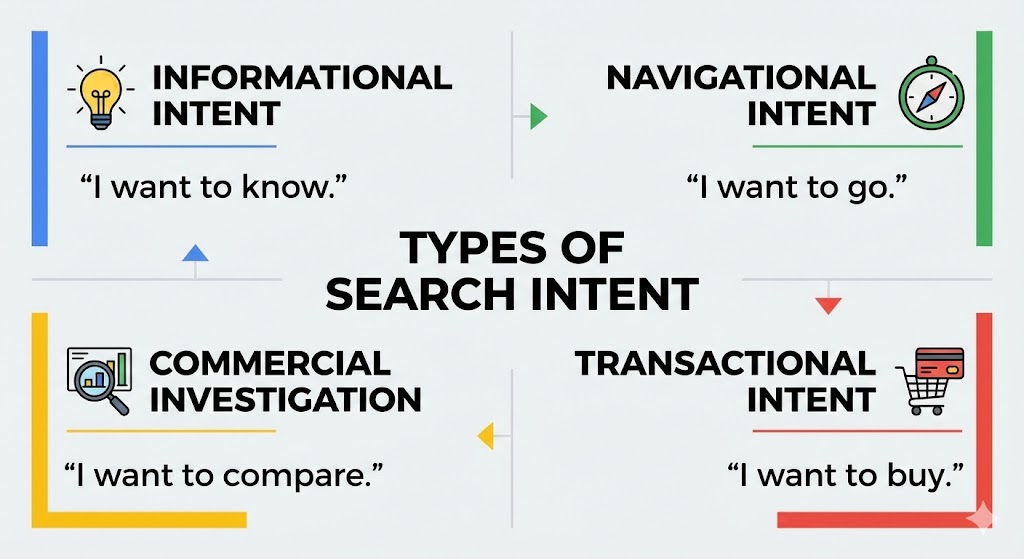
Types of Search Intents
Search intents could be classified into four types:
- Informational Intent (“I want to know”)
This is the most common type of search. The user is looking for information, an answer to a question, or a solution to a problem. They’re in learning mode.
- Examples: “how to fix a shingle,” “what is the average roof repair cost,” “types of roofing materials.”
- Navigational Intent (“I want to go”)
Here, the user already knows where they want to go. They’re just using the search engine as a shortcut to get to a specific website or page.
- Examples: “Facebook login,” “Yelp,” “Osborne Digital Marketing.”
- Commercial Investigation (“I want to compare”)
The user has a problem and knows they need a product or service, but they’re not ready to buy just yet. They are in the research and comparison phase, weighing their options.
- Examples: “best roofers in Jacksonville,” “asphalt shingles vs. metal roof,” “Rank Lightning reviews.”
- Transactional Intent (“I want to buy”)
This is the money stage. The user is ready to take action—make a purchase, hire a service, sign up for a demo, or book an appointment. Their intent is to convert.
- Examples: “roof repair Jacksonville,” “emergency roofer near me,” “buy roofing nails online.”
The Ultimate Litmus Test: Your Foolproof Guide to Keyword Intent Analysis
Now for the game-changing part. You don’t need expensive tools or a crystal ball to figure out intent. Google literally gives you a cheat sheet with every search. Here’s a simple two-step process for matching keywords to intent.
Step 1: Look for the Google Map Pack
This is the single biggest clue you can get for local searches. Type your keyword into Google and look at the top of the page. Do you see a map with three or four business listings underneath it? That’s the Google Map Pack (or Local Pack).
If you see a Map Pack, Google is screaming that the search has commercial or transactional intent.
Why? Because the Map Pack is specifically designed to connect users with local businesses they can hire or buy from right now. It doesn’t show up for purely informational searches. Think about it: Google wouldn’t show you a list of local plumbers if you searched “how does a toilet work?”
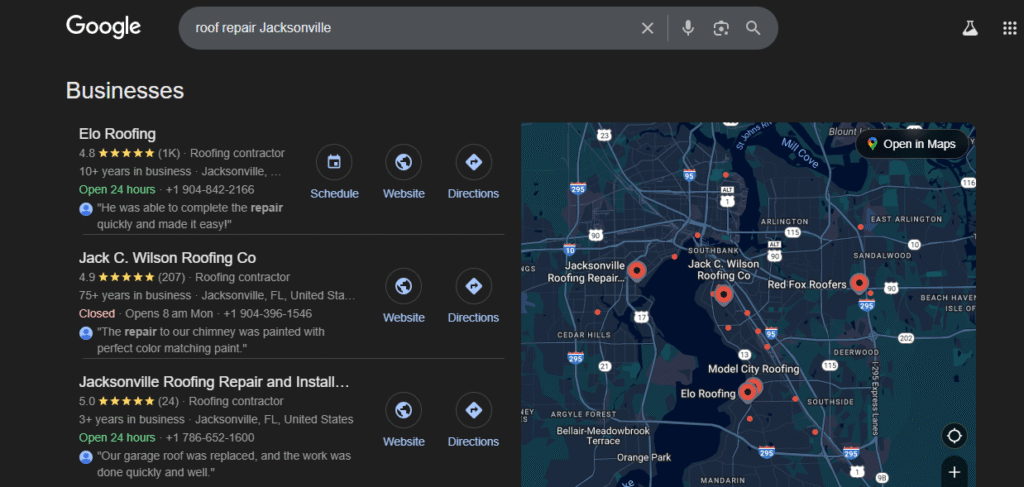
Let’s use a real-world example: roof repair Jacksonville.
When you search for this, a Map Pack appears instantly. Google’s algorithm has determined that people searching this phrase aren’t looking for a blog post. They’re looking for a contractor. This is your cue to create a money page: a service page, a location page, or even your homepage, optimized for conversions. This is the foundation of effective search intent optimization.
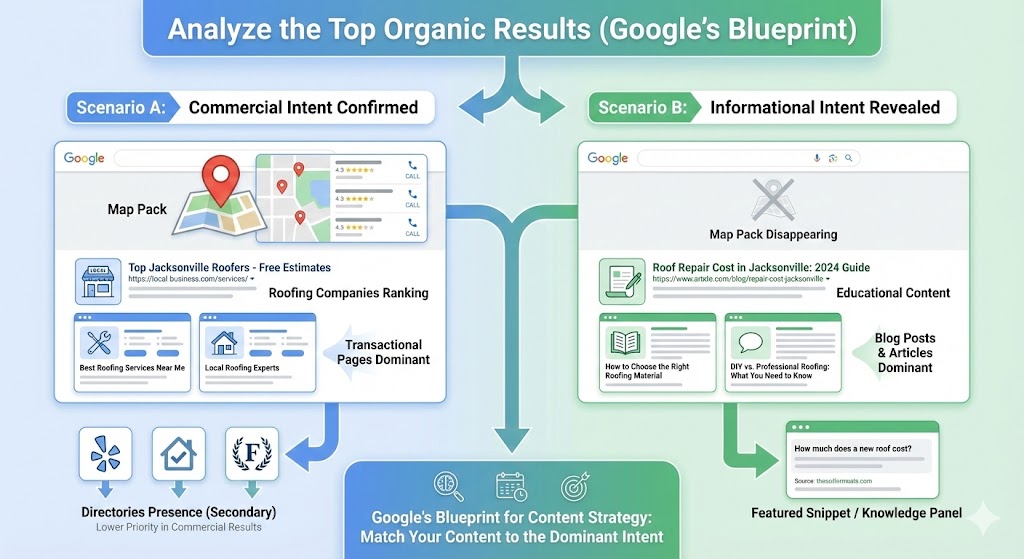
Step 2: Analyze the Top Organic Results (Google’s Blueprint)
The Map Pack is your primary signal, but you should always confirm your findings by scrolling down to the organic results. This is where Google shows you the exact type of page it believes best satisfies the user.
Scenario A: Commercial Intent Confirmed
For our roof repair jacksonville search, after the Map Pack, you’ll likely see the homepages and service pages of actual roofing companies. This double-confirms the transactional intent.
“But what about all the directories like Yelp, Forbes, or Angie’s List?”
You’ll often see big directories ranking for local service keywords. This is a form of parasite SEO or simply their high domain authority at work. Don’t let this confuse you. As a local roofer, your takeaway isn’t to create a “Top 10 Roofers” listicle on your own site. Your goal is to be one of the businesses on those lists and, more importantly, to rank your own commercial page alongside them. The presence of other actual businesses in the top 10 is all the proof you need.
Scenario B: Informational Intent Revealed
Now, let’s tweak our keyword slightly to jacksonville roof repair cost.
Notice a huge difference? The Map Pack is gone. This is your first major clue that the intent has shifted from transactional to informational. The user isn’t ready to hire; they’re in the research phase. They want to know, not buy.
Scrolling down to the organic results will confirm this. You’ll see:
- Blog posts titled “How Much Does a Roof Repair Cost in Jacksonville?”
- Guides and articles from roofing companies and home improvement sites.
- URLs that look like domain.com/blog/roof-repair-cost.
This tells you that trying to rank your primary “Roof Repair” service page for this keyword is a losing battle. Google wants a blog post. To succeed with an intent-based SEO approach, you must create a completely separate, in-depth informational article that answers the cost question directly.
How To Structure Your Content to Match Intent
Identifying intent is half the battle. The other half is creating content that is perfectly structured to meet that intent.
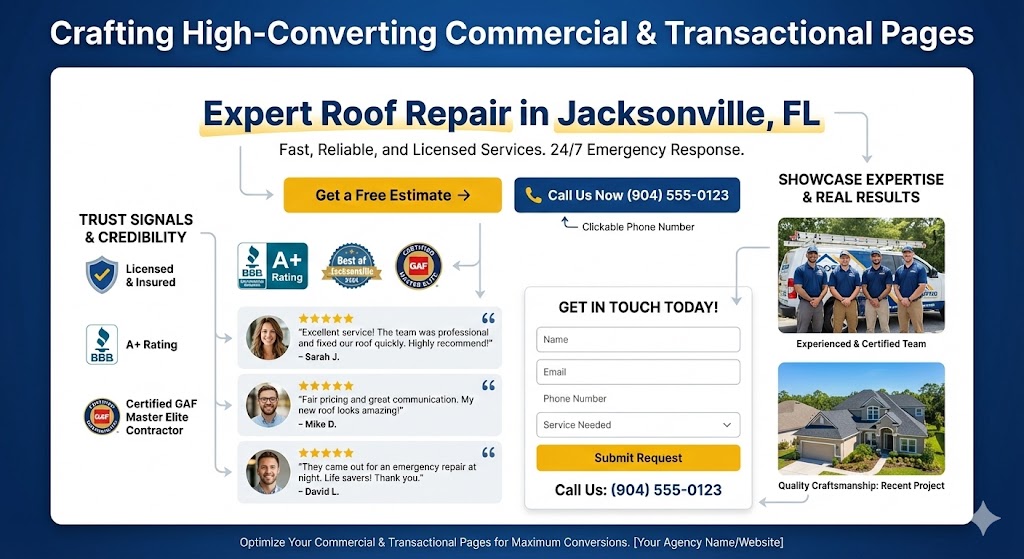
Crafting High-Converting Commercial & Transactional Pages
When your keyword intent analysis points to a “money” page, your entire focus should be on building trust and driving action. This isn’t the place for a 2,000-word history of roofing.
Your page must include:
- A Clear Headline: “Expert Roof Repair in Jacksonville, FL”
- Prominent Calls-to-Action (CTAs): “Get a Free Estimate,” “Call Us Now.”
- Social Proof: Customer testimonials, star ratings, and reviews.
- Trust Signals: “Licensed & Insured” badges, awards, years in business.
- Visuals: High-quality photos of your team and your completed projects.
- Simple Contact Info: An easy-to-use form and a clickable phone number.
Every element should guide the user toward contacting you.
Building Authoritative Informational Content
When the intent is informational, your job is to be the most helpful teacher in the room. Go back to the SERP for jacksonville roof repair cost and analyze the top-ranking pages. They are your blueprint.
Ask yourself:
- How is it structured? The top results likely use clear headings (H2s, H3s), bullet points, and maybe even a table breaking down costs by roof type or square footage.
- What questions do they answer? Look at the “People Also Ask” box on the SERP. These are questions Google knows users are asking. Include detailed answers to these in your content, perhaps in an FAQ section. This is a killer keyword research technique for informational content.
- How deep do they go? Do they cover costs for different materials (shingles, metal, tile)? Do they discuss factors that influence price, like the pitch of the roof or water damage?
- What visuals are they using? They probably have helpful images or diagrams to illustrate their points.
Your goal is to take this blueprint and create a resource that is more comprehensive, better structured, and easier to understand than anything else on page one.
The #1 Pitfall to Avoid in Your SEO User Intent Strategy
There’s one SERP feature that can lead you astray: sponsored ads.
You might see a commercial ad for a roofing company on an informational search like “roof repair cost.” It’s tempting to think, “Well, if they’re paying for it, it must be a commercial keyword!”
This is a trap. Advertisers can target almost any keyword they want, hoping to catch someone early in their buying journey. The ads section is governed by budget, not by Google’s organic algorithm’s understanding of user intent.
Your North Star should always be the organic results and the presence (or absence) of the Map Pack. These are the most reliable indicators of what Google truly believes its users want.
Conclusion: Stop Guessing, Start Analyzing
Mastering user intent keywords isn’t about some secret SEO voodoo; it’s about paying attention to the clues Google leaves for you. By using the SERP as your guide, you can confidently determine the “why” behind any search and build content that perfectly aligns with it.
To recap the simple process:
- Search your keyword.
- Look for the Map Pack. If it’s there, the intent is commercial/transactional. Create a service or “money” page.
- No Map Pack? The intent is likely informational. Create a comprehensive blog post or guide.
- Always analyze the top organic results to see the exact format and structure Google is rewarding.
Stop creating content in a vacuum and start giving your audience and Google exactly what they’re looking for.
Leave a Reply