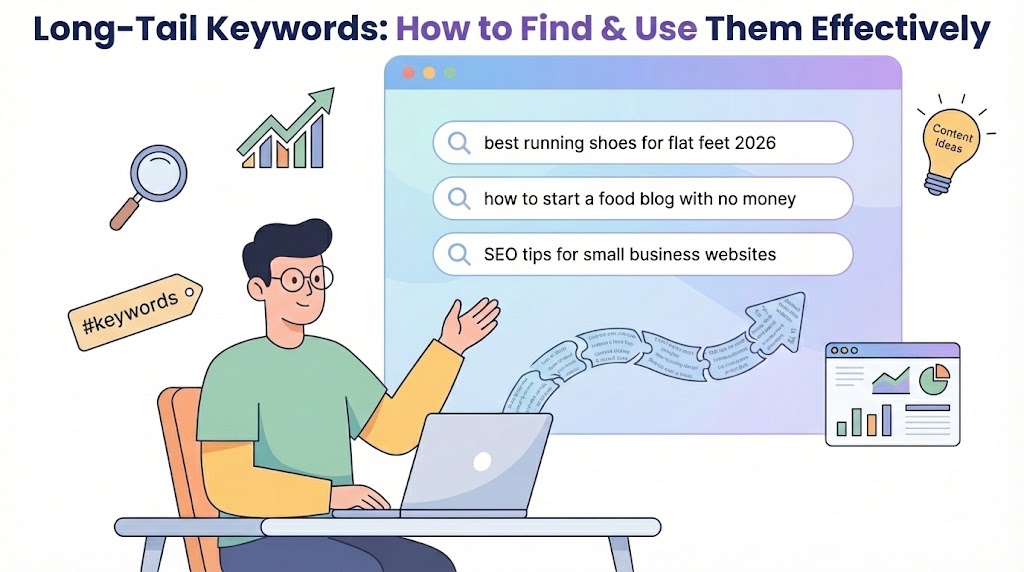
Ever searched for something super specific like:
- “how to bake chocolate chip cookies without butter”
- “best grain-free dog food for puppies with sensitive stomachs”
If yes, you’ve already used long-tail keywords.
While broad keywords get huge search volume, they rarely convert. Long-tail keywords attract users who already know exactly what they want and are ready to buy. That’s why these high-intent search phrases are gold for SEO and conversions.
In this blog, we will explain:
- What long-tail keywords are (with SEO-focused definitions)
- Why they matter for ranking and sales
- How to find long-tail keywords for blogs and e-commerce
- How to use long-tail keywords effectively without stuffing
- How to track your performance with real SEO tools
What Are Long-Tail Keywords?
A long-tail keyword is a highly specific search phrase that reveals strong purchase or action intent.
A keyword becomes “long-tail” the moment it removes ambiguity.
“Best shampoo” = too many possibilities
“Best shampoo for dry scalp men” = one very clear need
“Best sulfate-free shampoo for curly hair” = even better
And the best part?
As specificity increases, competition decreases but intent skyrockets.
That’s why a website with just 10 deeply targeted long-tail pages can beat a website publishing 100 generic blogs.
I’ve done this again and again.
Long-Tail Keywords vs Short-Tail vs Mid-Tail: Which One Should You Choose?
| Keyword Type | Example | Intent | Difficulty | Conversion |
| Short-Tail | “dog food” | Super broad | Very high | Very low |
| Mid-Tail | “best dog food” | Semi-specific | Medium | Medium |
| Long-Tail | “best grain-free dog food for puppies” | Strong | Low | Very High |
So, if you want traffic, go for short-tail keywords. But for revenue, long-tail keywords are the best option.
That’s why long-tail keywords for small business SEO work so well. You can bypass giant competitors.
Why Long-Tail Keywords Are The Best Option For SEO?
Let me break it down from my real-world experience:
1. They Convert Like Crazy
People searching long-tail keywords already know the problem and want the solution.
Higher intent = Higher sales.
2. Less Competition = Quicker Ranking Wins
You can rank fast even with a small/new website.
Perfect for:
- Freelancers
- Local businesses
- Blogs
- Affiliate websites
3. They Build Topical Authority
When I publish 10–20 long-tail blogs around a topic, Google starts trusting my entire site for that subject.

4. Voice + AI Search = Long-Tail Explosion
Most voice searches are like:
“Hey Google, what’s the best DSLR camera for beginners under ₹50k?”
Future SEO = Conversations → Long-tails rule here.
5. CPC is Cheaper in Ads
High buying intent + low competition = cheaper leads.
So yes — long-tail keyword strategy = smart SEO.
Two Types of Long-Tail Keywords I Focus On
A) Variant Long-Tail Keywords
Same meaning, different structure:
- “small kitchen makeover ideas”
- “how to remodel a small kitchen”
I target once, rank for all variants.
B) Dominant Long-Tail Keywords
The main popular way people search:
- “how to install floating shelves”
This becomes the primary keyword.
My rule:
One article = One dominant keyword + Multiple variants
That’s how I avoid keyword cannibalization.
The Truth About Competition Nobody Tells You
You’re not competing with 10 pages.
You’re competing with the top 3 results.
If those 3 results are:
- Big brands
- With massive topical authority
- And hundreds of backlinks
You’re done.
But if they are:
- Forums
- Old unoptimized articles
- Thin content
- Generic indexed trash
You can outrank them with:
- Better targeting
- Better structure
- Better coverage
- Better internal links
Finding keywords where Google is already unhappy with results
= the fastest path to ranking.
This is why long-tails win.
How I Actually Find Long-Tail Keywords (The Real SEO Work)
I don’t start with “keywords”.
I start with problems.
I ask:
- What are people struggling with?
- What are they trying to fix today?
- What decision are they about to make?
- What fears do they have before buying?
Then I go where those problems are discussed:
- Reddit threads (confessions + complaints)
- Quora questions (confusion + curiosity)
- Facebook Groups (real urgent pain)
- Product review pages (dissatisfaction)
- YouTube comments (unfinished answers)
Every time I find a specific frustration, I turn it into a keyword.

Example:
Reddit post: “My dog keeps itching even after switching to grain-free food”
This becomes:
- “dog itchy after grain-free food”
- “grain-free dog food allergies symptoms”
- “best dog food for itchy skin grain-free”
These keywords do not come from tools.
They come from human language.
Keyword tools only help me validate what I’ve already found.
The Evaluation Step (Where Most People Fail)
A long-tail keyword must pass these 3 filters:
1. Intent Fit
Can I provide the best answer to this search?
If yes → green flag.
2. SERP Opportunity
I check the top 5 results and ask:
- Is the content shallow?
- Are they missing important sub-topics?
- Are there unanswered questions?
- Are review sites dominating?
- Is there room for personal experience?
If I can be more helpful, I choose that keyword.
3. Business Value
Will this traffic lead to:
- Sales?
- Leads?
- Affiliate clicks?
- Newsletter signups?
I only write if there’s money behind it.
Traffic without revenue is a vanity metric.
How I Use Long-Tails in Content (Not Keyword Stuffing)
I don’t “force” them into paragraphs.
I structure the content around the exact doubts people have before acting.
Here’s my real approach:
- Primary long-tail keyword = main promise of the page
- Variants = each becomes a sub-intent
- Questions = address them before the user asks
I like to imagine the reader sitting beside me saying:
“Okay, but what about this?”
✨ And I answer it right away.
That’s how I:
- reduce pogo-sticking (people leaving quickly)
- increase scroll depth
- increase conversion
Which → increases ranking.
Google tracks satisfaction.
I design content to satisfy.
The Secret: Long-Tails Are Not One-Off Pages
They are topic signals.
Google sees patterns.
If you:
- cover multiple angles of a problem
- interlink pages in a helpful flow
- keep users within the topic
Google says:
“This site deeply understands this subject.”
And once that happens…
You start ranking for bigger, broader keywords too — without even targeting them.
This is how tiny niche blogs beat authority giants.
Final Truth (From My Experience)
SEO used to be about:
- backlinks
- word count
- keyword density
Now SEO is about:
- giving people exactly what they want
- better than anyone else
Long-tail keywords are just a doorway to doing that.
If you understand:
- intent
- pain
- decision triggers
…you will never run out of traffic.
And you will never struggle to convert.
Because everything becomes simple:
Help real people with real needs →
Google rewards you.
They reward you.
That’s SEO.
That’s long-tail strategy.
That’s why I bet on it every single time.
Also Read: New SEO Rules in 2026: What You Need To Know
Leave a Reply